This is the big one – the core goal. Everything else is icing on the cake, or trying to get fun at the same time as fitness.
Long-term hormone therapy means my muscles will waste away, and I’ll gain fat even more easily than before (and that was already remarkably easy for me).

Okay, there’s a bit of vanity here. I want my kids to think of me as strong, I want to still be able to throw them around and play for as long as possible.
But it’s not just vanity. Studies show that resistance training improves survival outcomes for prostate cancer patients. That’s why PureGym has started offering free memberships to people with stage 4 prostate cancer (https://www.puregym.com/prostate-cancer/). Hopefully other gyms will follow, and expand the offer to anyone going through cancer treatment — because the evidence is clear: exercise, including resistance training, improves outcomes for everyone.
And it’s not just about cancer. It improves outcomes for those without it too, so maybe we should all take it a bit more seriously.
I’ve never enjoyed resistance training. It’s dull, repetitive, and you don’t get the same satisfying sweat as with cardio. You can’t even watch TV while doing it. I liked some of the functional lifting in CrossFit, but didn’t love the obsession with technique and speed. And if I’m honest, I find the “gym bros” intimidating — everyone seems to know what they’re doing and is lifting more than my bodyweight. But I suppose they all started somewhere.
Resistance training being key for my survival, it’s officially part of my Above Average plan. (Can I get “above average” with Prostate Cancer?) The gym it is.
How I’ll Measure Progress
There’s plenty of room to improve. At the start of chemotherapy, I couldn’t do a single proper push-up. Based on some Googling, these are my provisional “above average” targets which are worth building towards now:
Squat – Target: Bodyweight.
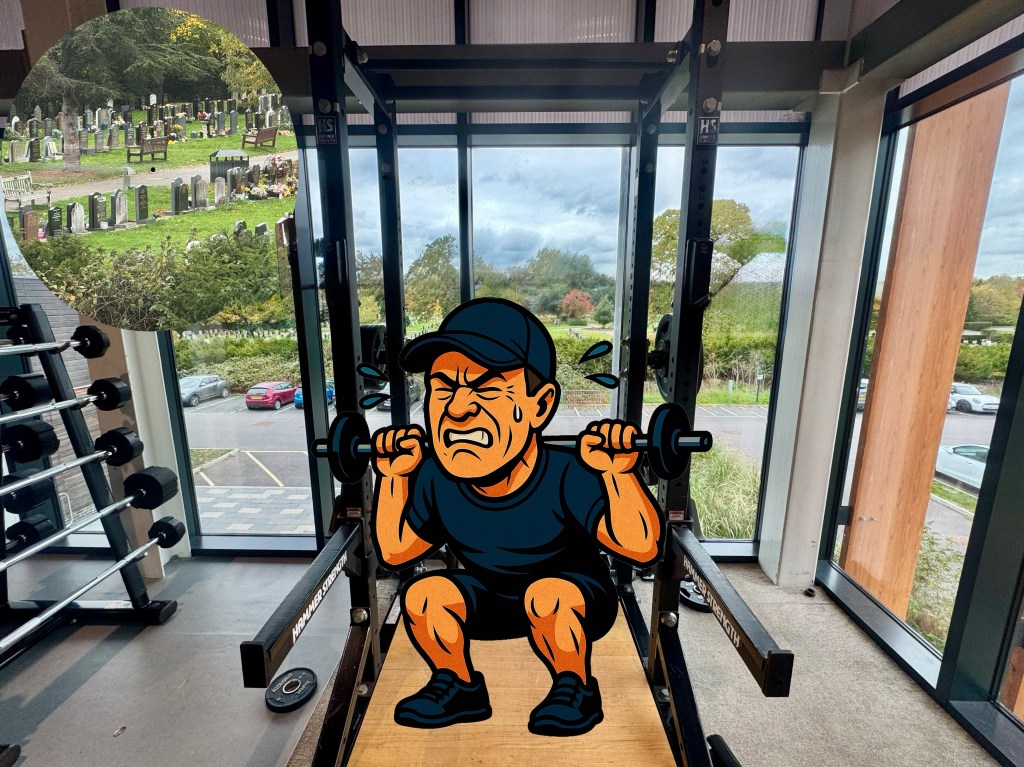
I used to have regular lower back issues, but air squats helped loosen things up. Apparently, countries that use squat toilets have fewer lower back problems — so maybe they’re onto something. I’ve been building up on the Smith machine for control, and recently switched to free squats (with a surprisingly inspiring view of a graveyard). I’m now at 70kg (20kg bar + 50kg plates), and with my weight down from 131kg to 90kg, bodyweight squats seem within reach. My front squat is shakier — 40kg feels precarious, perhaps because years of carrying a tuba on my back built my back squat but ruined my front.
Bench Press – Target: 0.75× bodyweight.
Tried this with my brother spotting me and quickly realised I’m miles off. I’ve switched to the Smith machine and currently manage 38% of bodyweight (bar + 15kg). Progress is slow but steady — and hopefully push-up gains will transfer.
Deadlift – Target: 1× bodyweight.
Apparently one of the most functional lifts — after all, life is basically picking things up off the floor. Given my weekly shopping bills, I assumed I’d be a natural. Haven’t tested it yet though; I’ve watched enough YouTube tutorials on Romanian versus conventional form to feel almost confident. Almost.
Push-ups – Target: 25 continuous full push-ups.
I couldn’t do one when I joined the gym, which was humbling. Now I can string together six full ones before dropping to my knees. Progress feels tangible here — and it’s oddly motivating.
Pull-ups – Target: 10 continuous full pull-ups.
If push-ups were humbling, pull-ups are humbling squared. I’m using the assisted machine for now, reducing the assistance weight each week, working toward my first unassisted rep.
What’s Next?
These are my “above average” benchmarks — not perfection, but progress. Am I missing a key metric, or aiming too low? The goal isn’t just to look strong, but to be strong enough to fight cancer, stay functional, and keep up with my kids.
I don’t think Resistance training will ever become fun for me, but it’s a kind of defiance — every rep is a quiet “not yet” to that graveyard, and that’s reason enough to show up and keep going.
 Fighting Stage 4
Leave a comment